
17 October 2026 · M. Chinnaswamy Stadium, Bengaluru · Pre-match analysis
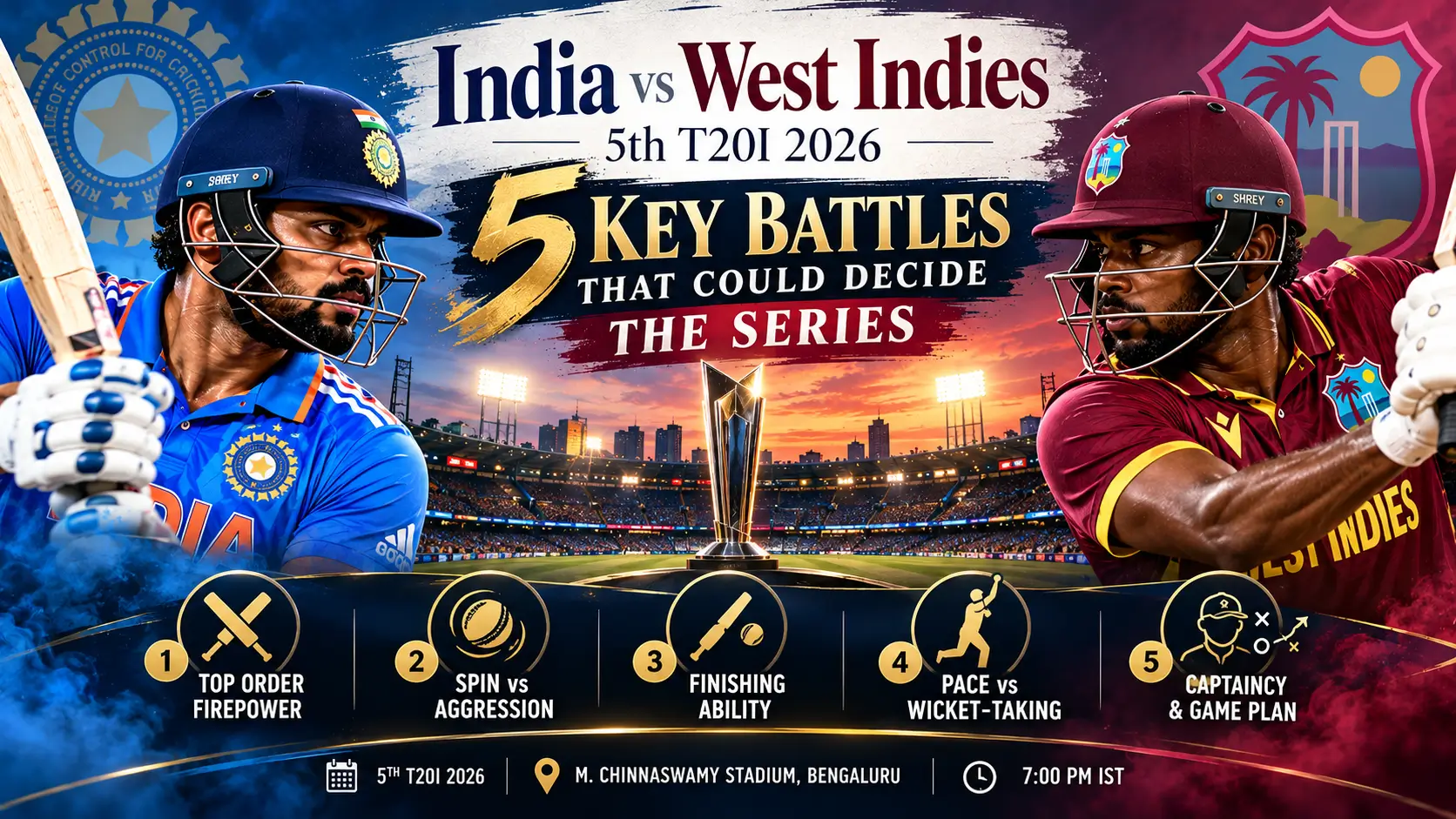
Five moments could matter more than any pre-match prediction when India and West Indies meet in the fifth T20I. Rather than retell every score from the series, this guide examines the individual and tactical matchups likely to shape the decider.
Battle 1: Shai Hope vs India’s new-ball bowlers
Hope’s unbeaten Hyderabad century showed the cost of allowing an established batter to control both strike and boundary options. India’s opening bowlers need more than a defensive field: their first task is to make Hope play from less comfortable positions, particularly when the ball is hard and fielding restrictions apply.
Watch for whether the seamers vary their release angle and length without offering easy width. A couple of quiet overs could force risk, but attacking too predictably can also feed his strongest shots. The meaningful metric is not only Hope’s score; it is how many deliveries he faces before India create a genuine wicket chance.
Battle 2: Sanju Samson vs West Indies’ middle-over spin
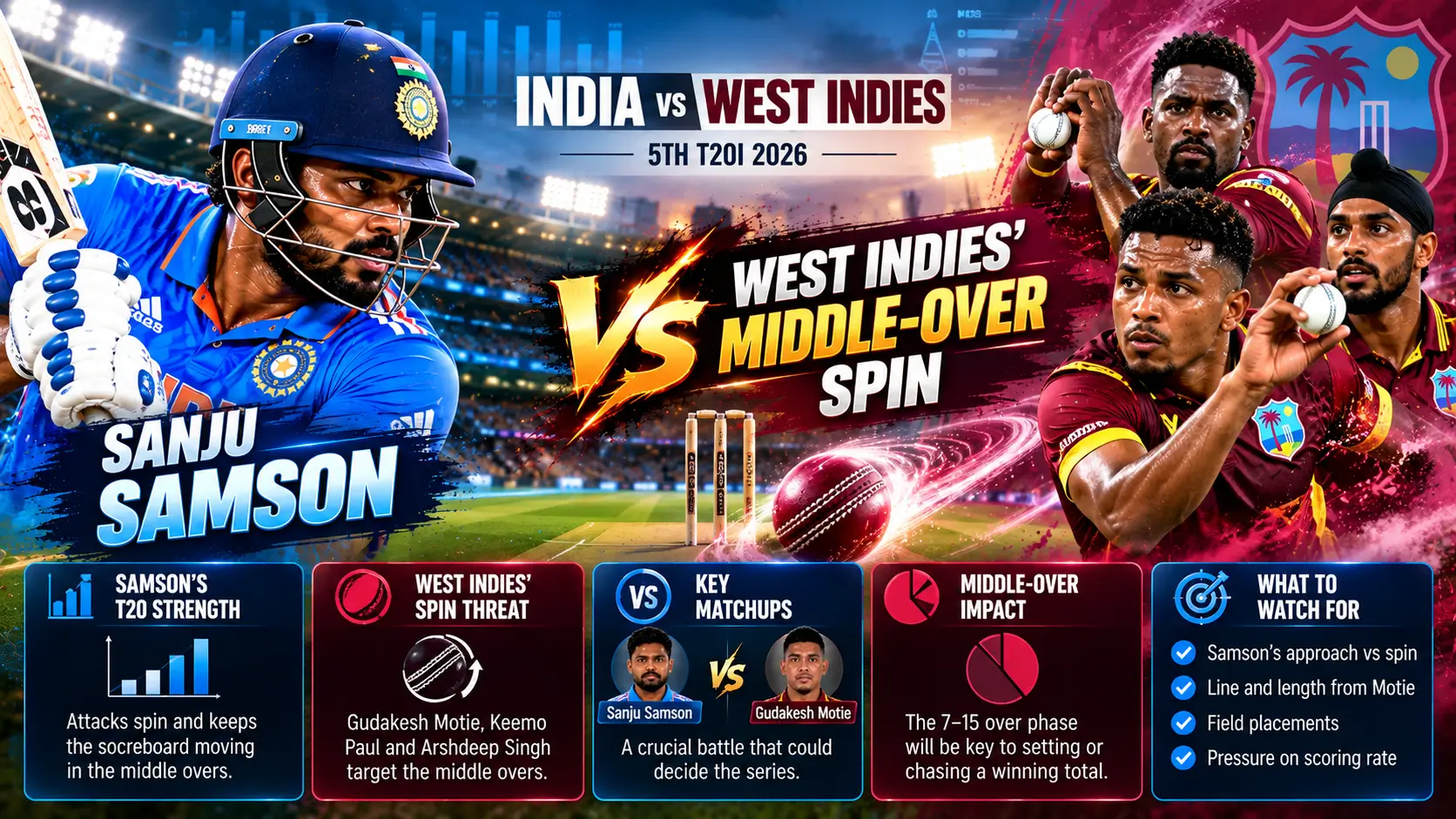
Samson’s 56 from 23 balls in Hyderabad demonstrated how quickly he can transform a chase. Yet the match also highlighted the need to carry that early acceleration into overs seven to fifteen. Gudakesh Motie’s middle-over wickets disrupted India’s rhythm in the fourth match.
In Bengaluru, the interesting question is whether India use Samson as an all-out attacker or protect the innings with a partner tasked with rotation. The ideal answer depends on wickets in hand and the required rate. Look for strike rotation after boundary balls: it can prevent spin from dictating the tempo.
Battle 3: India’s death bowling vs Sherfane Rutherford
Rutherford’s unbeaten 49 in Hyderabad illustrated the danger of letting a finisher arrive against predictable late-over plans. India’s death-over execution will depend on clarity: which lengths are realistic on the day, where the boundary fielders stand, and how quickly the bowler adjusts after a missed yorker.
A successful death over does not require six perfect deliveries. It requires reducing repeatable scoring opportunities. Wide lines, changes of pace and hard lengths all have a place, but only when they fit the pitch and field. If Rutherford is set by the final four overs, India’s margin for error will be small.
Battle 4: Keemo Paul’s variations vs India’s lower-middle order
Paul’s 5/41 in the fourth T20I made him a central tactical figure. When batters need rapid runs, changes of pace can tempt early swings and miscued shots. India must identify his slower deliveries without becoming passive against hittable balls.
Watch the response of India’s batters immediately after a wicket. A new player facing a bowler with momentum may need a few balls to read the pace of the surface, while the set batter can carry more of the attacking load. This contest may be decided by shot selection rather than raw power.
Battle 5: Bengaluru conditions vs both captains’ bowling plans
M. Chinnaswamy Stadium has a reputation for attacking white-ball cricket, but no historical scoring pattern can establish the exact pitch behaviour on match day. A fresh surface, moisture and dew can alter which bowling plans work.
Both captains must decide whether to reserve their most adaptable bowlers for the end or use them earlier against dangerous batters. The toss may influence that choice, but confirmed team selection and live conditions matter more than a blanket rule that chasing is always preferable.
Five matchups at a glance
| Matchup | What to watch | Potential turning point |
|---|---|---|
| Hope vs new ball | Early control of line and length | Wicket inside the powerplay |
| Samson vs spin | Strike rotation and risk selection | Overs 7–15 |
| Rutherford vs death bowlers | Variations and field placement | Final four overs |
| Paul vs middle order | Reading slower deliveries | First over after a wicket |
| Captains vs conditions | Bowling allocation and dew | Toss and in-game adjustments |
How fans can follow the tactical contest
Fans can make a simple over-by-over note of powerplay wickets, dot-ball sequences, bowling changes and boundary patterns. These observations reveal more about a T20 game than a single projected winning percentage. Match analysis should remain separate from commercial services: an Online Cricket ID is not required to follow official cricket scores, statistics or highlights.
For readers researching cricket-related online services, onlinecricketid.life is a separate third-party website. Its offerings and legal availability are not verified here; readers should check applicable local laws and platform terms before using any such service.
What would an India win look like?
India’s most plausible path is to dismiss at least one key West Indies batter early, avoid a sustained surge in the final overs, and preserve enough wickets for a controlled middle phase when batting. West Indies can counter by keeping Hope or another top-order player at the crease deep into the innings and using their variations to interrupt India’s partnerships.
Neither scenario is certain. The decider is best understood as a series of matchups, each of which can change with one wicket, one costly over or a tactical bowling switch.
Frequently asked questions
When is the fifth T20I scheduled?
17 October 2026, with the scheduled start at 7:00 PM IST in Bengaluru.
What is the series score before the fifth match?
2–2, according to the pre-match series results.
Which players are central to this tactical preview?
Shai Hope, Sanju Samson, Sherfane Rutherford, Keemo Paul and Gudakesh Motie.
Check the ICC website and Cricket West Indies for official match updates and scorecards. This article is a pre-match analysis dated 15 October 2026; update it after the game.